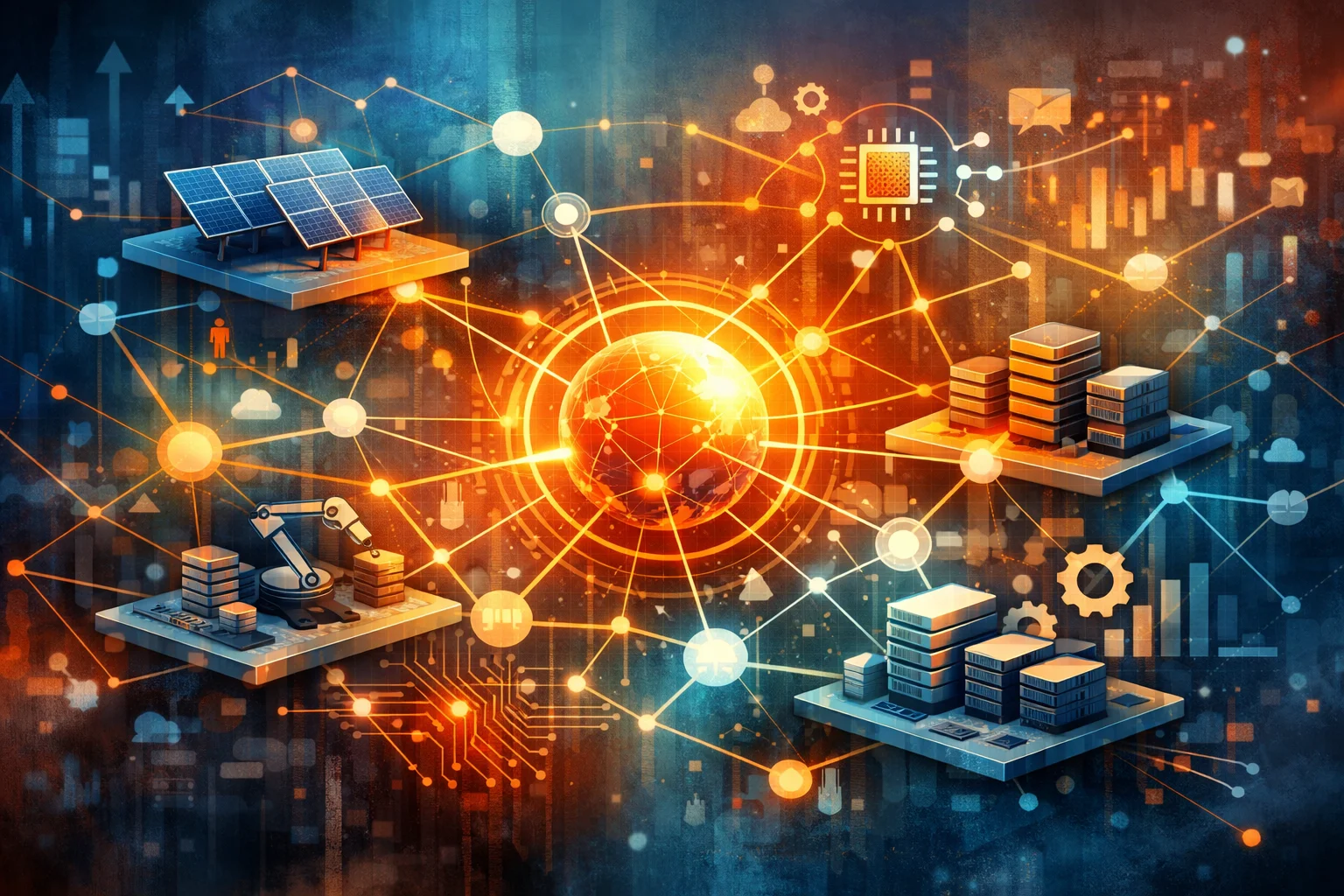
The industry is in the middle of a structural shift. From product businesses to platform businesses. Hardware plus software. Equipment plus services. Integration plus lifecycle ownership.
This isn't just a trend. It's a survival response.
Two forces are colliding right now.
First: Market contraction. When capital tightens and margins compress, companies move upstream and downstream to capture margin and reduce dependency. Integration becomes defensive. It protects IP, secures supply chains, and preserves pricing power.
Second: Scale creates accountability. Solar is now the fastest-growing source of new generation added to the grid. With scale comes responsibility: performance guarantees, bankability, grid reliability, lifecycle optimization. Companies that can afford to vertically integrate will integrate. Most cannot. It's a step-function transition.
We've seen this movie before. Apple built the full stack around iOS to control outcomes. Control the stack, control the experience.
The FriendlyNode Framework
Back in 2019, while at Nevados Engineering, I started developing a framework for thinking about this. I called it FriendlyNode.
The core idea is simple.
Your company is a node in an industry network.
You're not isolated. You sit inside a network of customers, suppliers, competitors, regulators, and capital providers. Customers emit demand signals. Requests for lower LCOE, higher reliability, faster deployment, lower risk. Multiple companies compete to convert those signals into value.
The companies that process demand faster, cheaper, and more reliably gain share. The companies that fail to process information efficiently lose connectivity. Disconnected nodes die.
And your company is also a network internally.
Every organization has internal nodes: people, teams, systems, AI agents, capital allocation mechanisms. A customer request flows from node to node. Sales to engineering, engineering to supply chain, supply chain to field execution. The speed and accuracy of that internal flow determines your external competitiveness.
Nextpower is leading the pack.
It's not just vertical integration. It's becoming a higher-order node.
By integrating hardware, software, analytics, and services, Nextpower is:
- De-risking IP and maintaining freedom to operate
- Reducing handoffs and increasing information flow speed
- Aligning incentives across the value chain
- Moving from reactive component supplier to proactive platform
That's a FriendlyNode in action.
Instead of reacting to external volatility as a narrow supplier, they're strengthening their connectivity in the network. Receiving demand signals more directly, processing them internally with fewer friction points, and returning value with higher reliability.
But integration raises the bar.
A larger node has more internal complexity. More internal pathways. More opportunities for breakdown. Vertical integration magnifies execution risk. Owning the stack creates the opportunity for aligned performance. It doesn't guarantee it.
At utility scale, the winners won't simply have better technology.
They'll be the companies that build the most efficient, incentive-aligned, error-correcting nodes in the energy market. That's the real business model innovation happening right now.
You can learn more about the FriendlyNode framework at friendlynode.com.
If it resonates, I welcome the conversation. Reach out directly or share your thoughts.